When you’re managing data in the electronic manufacturing services space, the stakes couldn’t be higher. Sensitive data ranging from proprietary customer information to classified design files flows through your systems daily. Without proper compliance measures, you’re leaving your operation vulnerable to breaches that could wreak havoc on your business.

(freepik/Freepik)
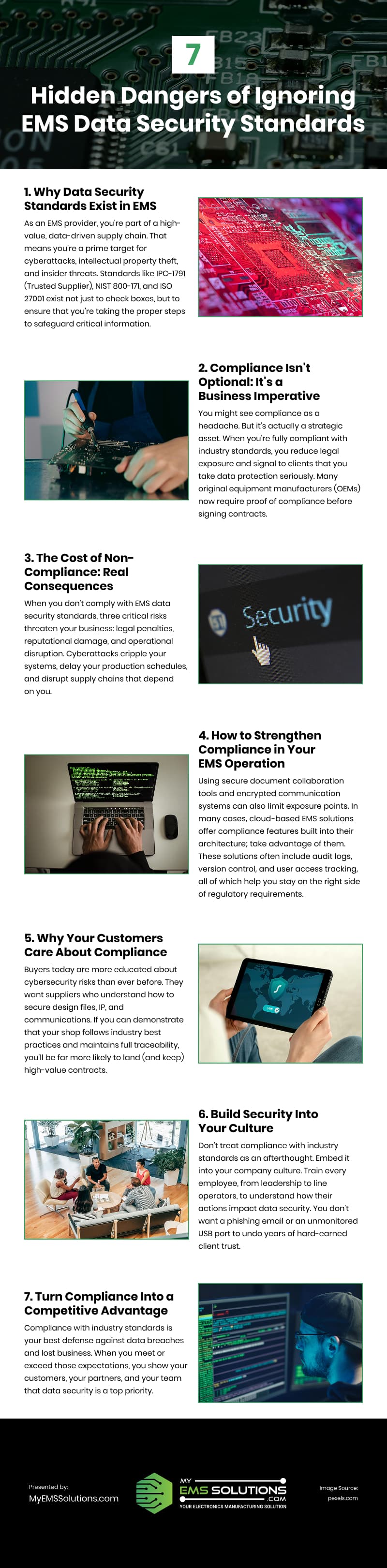
Why Data Security Standards Exist in EMS
As an EMS provider, you’re part of a high-value, data-driven supply chain. That means you’re a prime target for cyberattacks, intellectual property theft, and insider threats. Standards like IPC-1791 (Trusted Supplier), NIST 800-171, and ISO 27001 exist not just to check boxes, but to ensure that you’re taking the proper steps to safeguard critical information.
The requirements get even stricter if you work with government contracts, defense components, or high-end consumer electronics. In these sectors, you must implement robust access control, perform risk assessments, and maintain full traceability across your digital ecosystem.
If you’re thinking of bypassing these standards to save time or reduce paperwork, consider this: a single data breach can cost hundreds of thousands in remediation, fines, and lost contracts. That’s not a risk you can afford to take.
Compliance Isn’t Optional: It’s a Business Imperative
You might see compliance as a headache. But it’s actually a strategic asset. When you’re fully compliant with industry standards, you reduce legal exposure and signal to clients that you take data protection seriously.
Many original equipment manufacturers (OEMs) now require proof of compliance before signing contracts. Ignore these standards and you’re closing the door to high-value opportunities.
Take controlled unclassified information (CUI) as an example. NIST 800-171 compliance is mandatory under U.S. federal regulations. Failing to comply threatens your cybersecurity posture and can eliminate your eligibility for key contracts entirely.
The Cost of Non-Compliance: Real Consequences
When you don’t comply with EMS data security standards, three critical risks threaten your business:
1. Legal Penalties
Regulators can fine you for failing to meet data handling requirements. Affected customers can sue you for damages.
2. Reputational Damage
Security breaches spread through industry networks quickly. Lost client trust eliminates future business opportunities.
3. Operational Disruption
Cyberattacks cripple your systems, delay your production schedules, and disrupt supply chains that depend on you.
These risks hit small and mid-sized EMS providers especially hard. Cybercriminals frequently target smaller operations because they assume you have weaker defenses, making you an easier path to the valuable data you handle.
How to Strengthen Compliance in Your EMS Operation
If you’re serious about protecting data and winning the trust of high-end clients, your best bet is to integrate compliance into your everyday operations. Start by performing a gap analysis. Ask yourself:
- Are your systems regularly audited against relevant standards like IPC-1791 or ISO 27001?
- Do you maintain full traceability of all digital files and data transfers?
- Are your employees trained in data handling protocols and breach response procedures?
From there, implement an information security management system (ISMS) tailored to your operation. Document your policies, restrict access to sensitive files, and regularly monitor for vulnerabilities.
Using secure document collaboration tools and encrypted communication systems can also limit exposure points. In many cases, cloud-based EMS solutions offer compliance features built into their architecture; take advantage of them. These solutions often include audit logs, version control, and user access tracking, all of which help you stay on the right side of regulatory requirements.
Why Your Customers Care About Compliance
Buyers today are more educated about cybersecurity risks than ever before. They want suppliers who understand how to secure design files, IP, and communications. If you can demonstrate that your shop follows industry best practices and maintains full traceability, you’ll be far more likely to land (and keep) high-value contracts.
More importantly, you’ll gain a reputation for reliability, which, in this industry, is the ultimate currency.
Build Security Into Your Culture
Don’t treat compliance with industry standards as an afterthought. Embed it into your company culture. Train every employee, from leadership to line operators, to understand how their actions impact data security. You don’t want a phishing email or an unmonitored USB port to undo years of hard-earned client trust.
Consider investing in recurring security training, building automated alert systems, and designating an internal compliance officer who keeps your practices up to date with evolving regulations.
When you align your entire organization with industry standards, you make compliance seamless. You build resilient operations that scale safely and earn the long-term confidence of OEMs in high-security markets.
Turn Compliance Into a Competitive Advantage
Compliance with industry standards is your best defense against data breaches and lost business. When you meet or exceed those expectations, you show your customers, your partners, and your team that data security is a top priority. You also position yourself to grow in high-stakes sectors where trust and traceability are non-negotiable.
If your EMS operation needs a compliance review, act now. Don’t wait for a breach or a lost bid to remind you why these standards exist. Proactive protection is the only strategy that pays off in the long run.
Video
Infographic
In the electronic manufacturing services (EMS) industry, protecting sensitive data goes beyond risk avoidance, it’s critical for preserving your reputation and driving long-term business growth. This infographic reveals the hidden dangers of neglecting EMS data security standards.